

















Automated Salmon Filleting – Why More Processing Plants Choose the Marel MS 2730
In salmon processing, the filleting stage plays a critical role in raw material yield, final product quality, and overall production profitability.
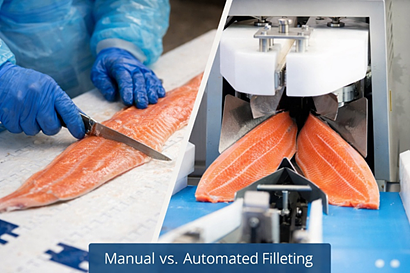
In many plants, filleting has traditionally been performed manually and, with proper organization, can deliver very good results. However, as production volumes increase and market requirements become more demanding, repeatability and process control are becoming increasingly important.
One of the solutions implemented in modern facilities is the Marel MS 2730 – an automated salmon filleting system developed by Marel, a manufacturer with decades of experience in industrial fish processing technology. Extensive expertise in both mechanical engineering and fully automated processing systems has resulted in a solution that ensures precise, stable, and consistent cutting performance.
Yield Optimization – The Foundation of Profitability
In manual filleting, the final result depends on several factors:
- operator experience
- working speed
- ergonomic conditions
- raw material variability
Even minor differences in knife handling can lead to trimming losses or residual meat left on the backbone.
A system such as the MS 2730:
✔ stabilizes fish positioning during cutting
✔ ensures repeatable filleting performance
✔ minimizes variation caused by human factors
In industrial-scale salmon processing, even small fluctuations in yield have a direct impact on plant economics.
Production Stability at Increasing Processing Volumes
Manual filleting continues to operate effectively in many facilities. However, as production capacity grows and customer specifications become stricter, uniform process parameters become essential.
Automation enables processors to:
✔ maintain consistent throughput at high volumes
✔ ensure repeatable fillet quality standards
✔ improve predictability in production planning
In an environment where delivery deadlines and batch consistency are critical, process stability becomes a key component of production management.
High-Quality Salmon Fillets as a Market Requirement
Today’s seafood market evaluates not only volume but, above all, final product quality. Retail chains and export markets require uniform structure, aesthetic appearance, and consistent fillet specifications.
Automated salmon filleting allows processors to:
✔ maintain a precise cutting line
✔ reduce product defects
✔ ensure consistent quality across batches
Optimized meat recovery combined with high and repeatable fillet quality while minimizing raw material losses directly supports customer requirements and reduces the risk of claims or rejections.
Addressing Labor Market Challenges
The fish processing industry faces increasing labor costs and difficulties in recruiting experienced production personnel.
Automated filleting systems help to:
✔ reduce dependency on workforce turnover
✔ limit physical strain on operators
✔ shift personnel toward quality control and process supervision
This approach stabilizes production without relying on variable human factors.
Integration Within a Complete Processing Line
The Marel MS 2730 can operate as part of an integrated salmon processing line, enabling processors to:
✔ optimize raw material flow
✔ reduce downtime
✔ improve workstation organization
✔ enhance hygiene standards
Automated filleting thus becomes part of a comprehensive technological system combining cutting precision with operational efficiency.
Implementing a system such as the Marel MS 2730 is not merely an investment in equipment. It represents a strategic shift in the way the filleting process is managed – toward a model focused on repeatability, parameter control, and predictable results.
Looking for equipment for your fish processing plant? Explore our selection of fish processing machinery and find the right solution for your production needs.